Many districts are actively evaluating student ridership tracking technologies right now, and the pressure driving that decision is real. School bus fleets across the United States are managing more complexity with fewer staff, tighter budgets, and families who expect answers in real time.
School district ridership tracking for student transportation has shifted from a nice-to-have to a core operational need. Whether your team is juggling driver shortages, rising parent call volume, or state funding audits, knowing exactly who boarded which bus and when changes how you respond, plan, and communicate.
Here are five reasons transportation teams are prioritizing ridership data right now.
1. Ridership Tracking Closes the Gap on Student Safety
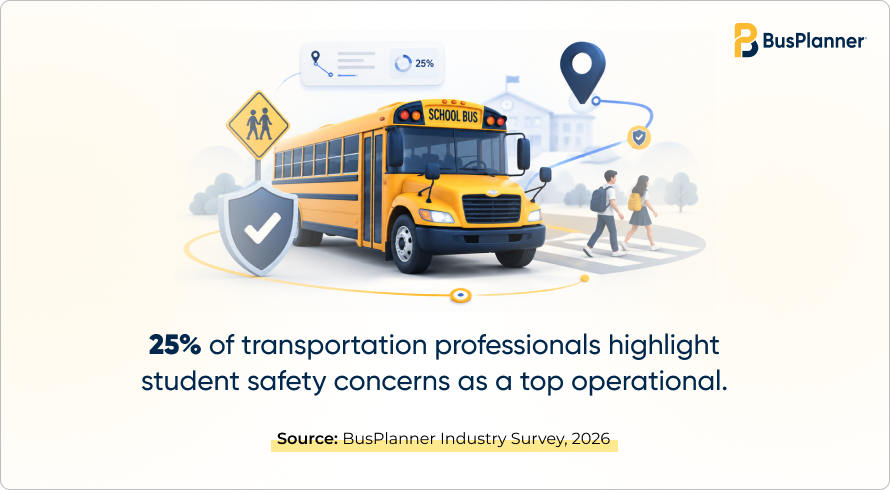
Transportation teams are often the last line of defense when something goes wrong during a student’s commute. A missed stop, a student who boards the wrong bus, or an unplanned route change can escalate quickly without reliable boarding and exit data. School district ridership tracking for student transportation gives your team a verified, time-stamped record of every student’s journey, so you can respond with facts instead of guesses.
- Accurate Boarding Verification: Knowing which students boarded and at which stop removes ambiguity during incidents. When a parent calls because their child has not arrived home, your team can pull a confirmed record rather than relying on a driver’s memory from hours earlier.
- Emergency Manifest Readiness: A live, accurate passenger list becomes critical during evacuations or accidents. First responders need to know exactly who is on the bus, and ridership systems provide that information instantly without requiring a manual headcount.
- Wrong-Bus Prevention: Students, especially younger ones, sometimes board the wrong bus. Ridership verification flags the mismatch at the point of boarding before the bus departs, giving drivers and dispatchers an opportunity to correct it immediately.
For a closer look at how real-time visibility supports safer daily operations, see How Technology Improves School Bus Route Planning.
2. It Reduces Parent Call Volume Significantly
Parent communication is one of the most persistent pressure points for transportation departments. Even districts that have invested in communication apps continue to field high call volumes because app adoption alone does not solve the underlying data problem. When ridership tracking provides real-time information directly to families, the need for parents to call the transportation office drops significantly.
Proactive Stop Notifications: Automated alerts let parents know when their child boards or exits the bus, which reduces the need to call the transportation office.
Reduced Manual Follow-Up: Without reliable ridership data, staff spend significant time making callbacks and providing repeated updates during delays or route changes. Automated, data-driven notifications replace that cycle with timely, accurate information.
Stronger Family Trust: Families who can see their child’s boarding status without calling develop greater confidence in the transportation department. That trust reduces escalations and improves overall satisfaction.
Learn practical ways your department can reduce incoming phone calls from parents using data and communication tools that work together.
3. Ridership Data Makes Route Optimization Far More Accurate
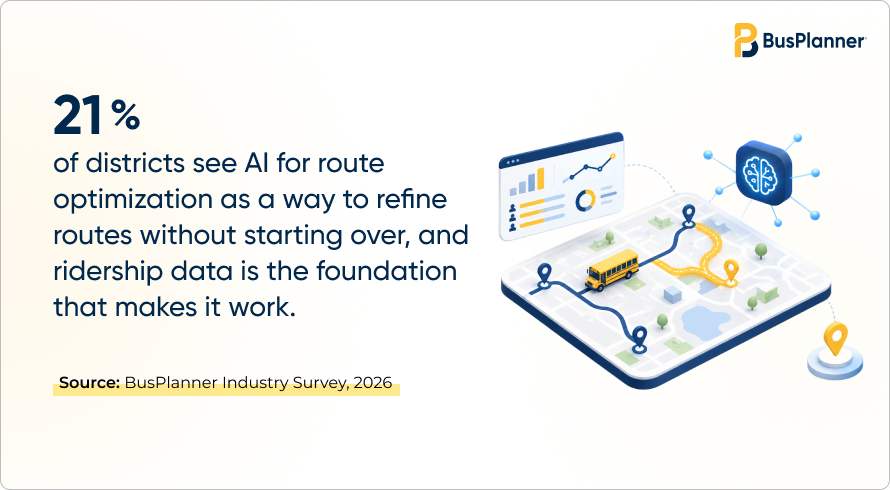
Most routing decisions are made using student eligibility lists and theoretical stop assignments. The problem is that actual ridership rarely matches those lists perfectly. Students move, custody arrangements change, participation shifts seasonally, and some stops see far fewer riders than expected. Without real ridership data, districts are optimizing against a map that does not reflect reality.
- Right-Sizing Bus Capacity: When you know average daily boarding counts by route, you can match vehicle size to actual load. Running a full-size bus on a route that carries twelve students is an avoidable cost that ridership data makes visible.
- Eliminating Ghost Stops: Stops with consistently zero or near-zero ridership can be safely removed or consolidated once the data confirms the pattern over time. That reduces route length, fuel consumption, and driver time simultaneously.
- Informing AI-Assisted Route Refinement: Transportation teams are increasingly interested in route optimization tools that refine existing routes without starting from scratch. Ridership data is the input those tools need to make recommendations that hold up in the real world. Explore how real-time tracking connects live GPS visibility with the routing decisions your team makes every day.
4. It Protects State Funding and Audit Readiness
State transportation funding formulas in most U.S. states are tied directly to ridership counts, eligible student records, and service documentation. Many states also require transportation records to be retained for audit purposes. Paper logs and manual tallies create gaps that auditors flag, and those gaps can translate into funding clawbacks or service eligibility disputes. Digital ridership records give districts a verifiable, time-stamped audit trail that stands up to scrutiny.
- Accurate Funding Documentation: Many states calculate transportation reimbursements based on student counts and days of service. Automated ridership records provide consistent, date-specific documentation that manual processes often cannot.
- Eligibility Verification Support: Ridership data helps transportation teams verify service delivery against student eligibility records. When eligibility changes mid-year, districts have a clear record of when the service started or ended.
- Faster Audit Response: When agencies request transportation records, digitized ridership data can be retrieved in minutes. Manual logs often take days to compile and may still contain gaps.
5. It Reduces the Workload on Already-Stretched Transportation Teams
Driver shortages and staffing challenges have stretched transportation departments across the United States. When teams are operating with limited resources, every manual task adds unnecessary pressure. School district ridership tracking for student transportation automates routine processes, giving staff more time to focus on planning, service delivery, and student safety.
- Automated Headcount Elimination: Manual headcounts at each stop add time to every run and introduce human error. Ridership systems handle that automatically, freeing drivers to focus on safe operation rather than paperwork.
- Simplified Daily Operations: When a driver calls in sick and a substitute takes the route, ridership data gives the substitute driver an accurate, up-to-date stop list tied to real student assignments rather than a printed sheet from last month.
- More Time for Strategic Priorities: By reducing repetitive administrative work, transportation leaders can focus more on route planning, staffing, and improving service quality.
Learn how Mobile Apps for Transportation Teams support more efficient day-to-day operations across K–12 transportation departments.
The Bottom Line
School district ridership tracking for student transportation is more than a single-purpose tool. It supports student safety, communication, route planning, funding compliance, and day-to-day operations. For transportation teams navigating driver shortages, rising parent expectations, and tighter budgets, ridership data helps bridge the gap between planned routes and actual service.
As more school districts adopt ridership tracking, transportation teams gain the visibility to make more informed decisions every day. Replacing manual records with accurate, time-stamped ridership data saves time, strengthens accountability, and supports better long-term operations.
Frequently Asked Questions
Q1. What is school district ridership tracking and why does it matter?
School district ridership tracking is the process of digitally recording when and where each student boards and exits a school bus, using tools like RFID cards, mobile apps, or GPS-linked systems. It matters because manual headcounts and paper logs leave gaps that create safety risks, funding errors, and avoidable parent communication failures.
Q2. How does ridership data help school districts protect state transportation funding?
Many U.S. states calculate transportation reimbursements based on student counts and service records, making accurate ridership data essential. Digital tracking systems create consistent, date-stamped documentation that simplifies audits, reduces paperwork, and helps districts respond to audit requests more quickly.
Q3. Why do parent communication tools alone not solve ridership visibility problems?
Parent apps are only as accurate as the data behind them. Without ridership tracking, families can see where the bus is but cannot confirm whether their child actually boarded. According to the BusPlanner Industry Report, 2026, 60% of transportation professionals still cite parent communication as an ongoing challenge despite using parent apps.
Q4. How does ridership tracking support route optimization for K–12 districts?
Route planning based on theoretical student lists often misses actual daily ridership. Ridership data shows which stops are consistently underused, allowing transportation teams to consolidate routes, reduce unnecessary mileage, and make routing decisions based on real usage rather than assumptions.
Q5. How much time can ridership tracking save transportation department staff?
The exact time savings vary by district size, but the benefits are consistent. Ridership tracking eliminates manual headcounts, reduces parent callbacks during disruptions, and speeds up audit documentation, giving transportation teams more time to focus on planning and service delivery.