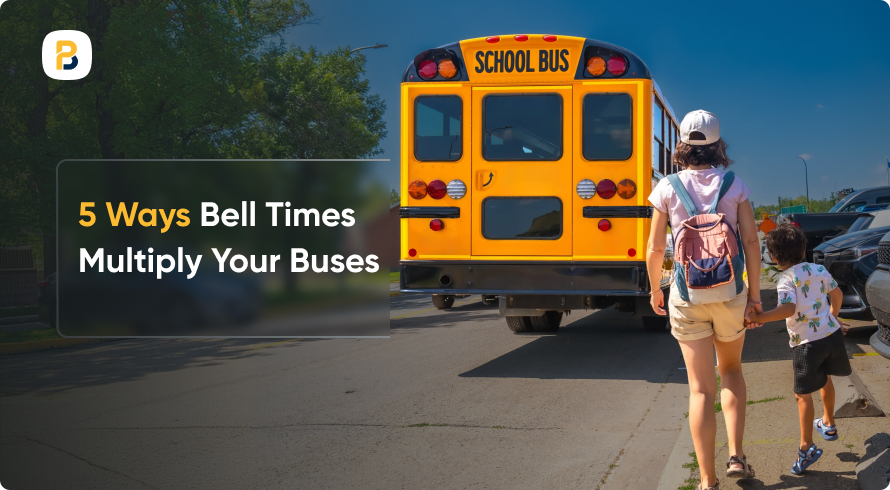
Every route a district runs needs a bus and a driver, and both are expensive and increasingly hard to secure. One of the largest factors in how many of each a district needs is often set without transportation in the room: the bell schedule.
When start and end times are staggered deliberately, a single bus can finish a run for one school and then serve a second, then a third. The same vehicle covers multiple schools in a morning instead of sitting idle between one dropoff and the next dismissal. Bell time design is what makes that reuse possible, and it is the difference between a fleet that scales efficiently and one that grows faster than enrollment does.
The five points below explain how bell schedules determine how far each bus can stretch, and what transportation teams can do to get more coverage from the buses they already have.
1. Staggered Start Times Let One Bus Serve Several Schools
A bus assigned to a single route at a single start time works for a few hours in the morning and then parks. Stagger the schools it serves and the same bus can run a high school route at 7AM, a middle school route at 8AM, and an elementary route at 8:30AM. Each additional tier is another bus’s worth of coverage without another bus in the lot.
Districts that build two or three tiers into the schedule routinely are able to serve the same number of students with a materially smaller fleet.
- Each Tier Is Coverage You Do Not Have to Buy: A second or third run on the same bus adds capacity at the cost of driver hours and fuel, not a new vehicle purchase and the years of maintenance that follow it.
- Idle Time Is Wasted Capacity: A bus that runs once and sits until dismissal represents expensive equipment doing nothing for most of the day. Tiering fills that gap with productive runs.
- The Savings Compound Across the Fleet: A reduction of even a handful of buses lowers purchase, maintenance, insurance, and storage costs at the same time, year after year.
2. Buffer Time Between Tiers Protects the Savings
Tiering only works if a bus can reliably finish one run and reach the next school’s stops before that bell. Cut the gap between tiers too fine and any disruption, from weather to a late release, cascades into the following tiers. Adequate buffer time is what keeps the reuse dependable instead of fragile.
Teams focused on keeping runs tight can look at where ride times are longest and most sensitive to delay. Our post on reducing student ride times covers how to find those pressure points.
- Deadhead Time Counts: The empty miles a bus travels between one school’s dropoff and the next school’s pickup area are part of the schedule math, not a rounding error. Compatible school pairings shorten that travel.
- Tight Windows Break First: The tiers with the least buffer are the ones that fail on a bad-weather morning, and a single failure erodes confidence in the whole structure.
- Reliability Is What Lets You Add Tiers: A district can only stack more runs onto a bus when the existing tiers hold up under pressure. Buffer time is what earns that room.
3. Grade-Banded Tiers Keep Buses Moving Efficiently

The classic three-tier model groups schools by level, high school first, then middle, then elementary, because each level keeps a different day length and the staggered bells line up naturally. Sequencing tiers by grade band and by geography lets a bus move through a service area in one logical direction instead of doubling back between runs.
- Grade Levels Come With Built-In Stagger: Different day lengths across high, middle, and elementary schools create the time gaps a tiered schedule needs, so grade banding is often the most efficient starting point.
- Geography Belongs in the Grouping: Assigning schools to tiers so each bus’s next pickup area sits close to where it just finished cuts empty travel and makes the connection between runs far more reliable.
- Health Rules and Fleet Math Have to Coexist: Later start-time requirements for older students are now law in some states, so tier design has to satisfy both the schedule constraints and the transportation budget at the same time.
4. Set Bell Times From Route Data, Not the Calendar Alone
Bell times are often chosen for academic or administrative reasons and handed to transportation as a fixed constraint. The schedule itself, though, decides fleet size. If one tier is overloaded and another runs light, the district has to own enough buses to cover the peak tier while the lighter tiers leave capacity unused.
Balancing runs across tiers is one of the most direct savings available to a transportation team, and it is a recurring theme in our roundup of cost-saving strategies for school transportation.
- Balance the Runs Across Tiers: Distributing routes so each tier carries a similar load prevents one peak tier from dictating a larger fleet than the district actually needs.
- Involve Transportation Before the Calendar Is Set: Bringing route data into the bell time conversation early lets a district weigh the fleet cost of each option instead of discovering it after the schedule is locked.
- Small Time Shifts Move Big Numbers: Moving one school’s bell by fifteen minutes can rebalance a tier and remove a bus from the requirement, a change that is invisible to families but significant to the budget.
5. Model the Scenarios Before the Calendar Is Locked
Bell time changes are difficult to evaluate by hand, which is why many districts default to the schedule they have always run. Routing tools let a team test a proposed schedule against real stop, ride-time, and driver data before anything reaches a board, and quantify how many buses each option requires.
Modern student transportation software with route optimization tools lets districts model bell time scenarios and see the fleet impact of each one before committing to a change.
- Test Before You Commit: Running a proposed schedule against current data shows whether the buffers hold and how many buses the plan actually needs, well ahead of the first day of school.
- Quantify the Trade-Offs: Ride times, driver hours, and bus counts all move together, and a model shows the full picture rather than one variable at a time.
- Bring Numbers to the Board: A schedule backed by modeled results turns a bell time debate into a budget conversation, which makes approval far more straightforward.
The Bottom Line: Bell Times Are a Fleet Decision

Bell schedules are usually framed as an academic and community question, and they are. They are also one of the most powerful levers a district has over the size and cost of its bus fleet. A schedule that staggers start times, spaces its tiers, and balances runs lets each bus do the work of two or three, while a schedule set without transportation input can quietly add buses a district cannot afford.
With a single new bus running well into six figures and drivers harder to hire every year, getting more coverage from the existing fleet is one of the highest-value moves available. Our industry insights and ebooks section offers additional data for teams ready to look closer at their own numbers.
Frequently Asked Questions
Q1. How do bell times affect the number of buses a district needs?
Bell times determine whether a single bus can serve more than one school in a morning. When start and end times are staggered, a bus can complete a run for one school and then run for another, which means fewer total buses cover the same students. When bell times are not staggered, more schools need service at once, and the district has to own enough buses to cover that peak. The bell schedule effectively sets the minimum fleet size.
Q2: What are tiered or staggered bell times?
Tiered bell times assign schools to a set of staggered start and end times so that one bus can serve several schools in sequence. A common approach uses three tiers, with high schools starting first, then middle schools, then elementary schools. Because each level runs at a different time, the same vehicle can carry a full load from each one across the morning rather than sitting idle between runs.
Q3: How much can tiered bell times save a district?
Savings depend on how well the tiers are designed and balanced, but transportation routing specialists commonly report fleet reductions of 15 to 40 percent when tiering is executed well. In one widely cited example, Boston Public Schools cut its fleet by about 50 buses and saved an estimated $5 million a year by optimizing bell times alongside its routes. Every bus a district avoids buying also lowers ongoing maintenance, insurance, and storage costs.
Q4: How much buffer time is needed between bell tiers?
There is no single rule that fits every district, but very tight windows are risky. When there is less than about an hour between one school's dismissal and the next school's first pickup, a bus has little room to absorb traffic, weather, or a late release, and one delayed run can push the following tiers behind. Adequate buffer time is what keeps a tiered schedule dependable rather than fragile.
Q5: Can bell time changes be tested before they are adopted?
Yes. Routing tools let a district model a proposed bell schedule against real stop, ride-time, and driver data and see how many buses each option requires before any change is presented to a board. Modeling the scenarios turns a bell time decision into a numbers conversation and reduces the risk of a change that looks good on paper but creates cascading delays in practice.