Rising costs, driver shortages, and changing enrollment are pushing student transportation departments to keep service running while making every route, driver, and budget dollar count.
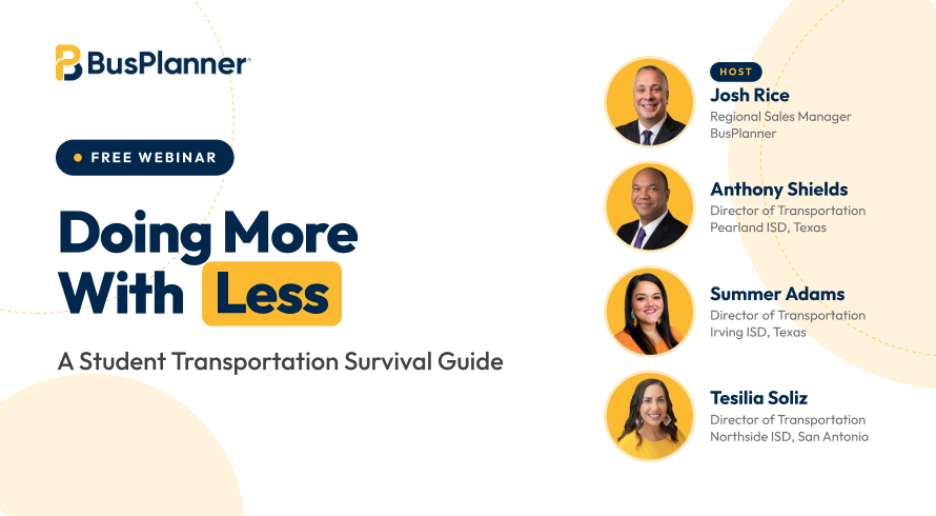
BusPlanner explored this challenge in its recent webinar, “Doing More With Less: A Student Transportation Survival Guide.” Josh Rice moderated a discussion with three student transportation leaders:
- Anthony Shields: Director of Transportation, Pearland ISD, TX
- Summer Adams: Director of Transportation, Irving ISD, TX
- Tesilia Soliz: Director of Transportation, Northside ISD, TX
Although each district operates differently, the discussion kept returning to four opportunities: aligning routes with actual ridership, improving funding records, supporting drivers, and communicating decisions clearly.
Budget Pressure Is Already Changing Student Transportation Decisions
While each state sets its own funding rules, districts from coast to coast are running into many of the same challenges:
- Rising fuel and operating costs
- Aging vehicles
- Driver shortages
- Enrollment changes
- More complex student transportation needs

Where can student transportation leaders begin? The panel identified four practical areas.
1. Keep Routes Connected to Actual Ridership
Routes do not remain efficient automatically. Enrollment shifts, ridership patterns become clearer, and new programs change where students need transportation.
Anthony Shields explained that his team continuously reviews ridership and stop data instead of relying only on the information available when planners created the routes. As passenger counts become clearer, the team can identify possible consolidations and other route adjustments.
At Irving ISD, Summer Adams followed a similar process:
- Her team monitored ridership from the beginning of the school year.
- That review helped the district reduce two high school routes.
- The data now supports planning for another choice school.
- The district is also considering tiered scheduling or shuttle-style service.

Regular reviews help transportation teams determine whether routes still match current demand. Looking at stops, actual ridership, vehicle loads, runs, and deadhead miles can show where adjustments may be needed.
A low passenger count does not always mean a district should remove a route. Some routes serve smaller groups of students for valid operational reasons. Current data helps leaders understand the difference.
2. Make the Data Behind Funding Count
Completing a funding report is only one part of the process. The student, mileage, eligibility, and service records behind it also need to be accurate.
Anthony Shields described two options available to Pearland ISD for students who lived closer to campus:
- Extend eligibility through a policy adopted by the school board.
- Offer families a paid transportation service.
Pearland ISD chose the paid option. Anthony presented the decision as a trade-off rather than a solution that would work for every district. Transportation leaders should compare the financial and operational impact of each available approach before moving forward.
Teams can also work backward from the final funding report:
- Review Eligibility Records: Confirm that student records reflect current district and state requirements.
- Verify Mileage: Make sure reported mileage matches the service provided.
- Trace the Figures: Check whether the department could support each figure if someone questioned it.
- Reconcile Records Early: Address missing or conflicting information before the submission deadline.
Accurate records help districts account for all eligible student transportation when funding is calculated.
3. Keep the Drivers You Have
Driver availability remains a major operational concern. The webinar’s second audience poll showed that driver retention tied with special education transportation as the top pressure facing attendees.

Retention depends partly on what drivers experience every day, including their assignments, opportunities, recognition, and access to leadership.
The panelists shared different ways to manage assignments. At Northside ISD, Tesilia Soliz explained that seniority plays a major role in how the district supports its veteran drivers, from the routes they can apply for, such as longer magnet school routes, to how field trips are awarded through the bidding process.
Irving ISD takes a different approach, using a point system for field-trip assignments that considers attendance, seniority, and positive feedback from schools.
There is no single system that will fit every district. The important question is whether drivers understand how leaders make decisions and view the process as consistent.
Leadership visibility also matters.

When supervisors and directors spend time around the operation, drivers can raise concerns about routes, schedules, students, equipment, or communication directly. Leaders can then address the issues within their control before those frustrations contribute to turnover.
4. Communicate Changes Before They Create Questions
People outside the student transportation department also need to understand operational decisions.
Different audiences need different information:
- Families: What is changing, when it takes effect, and how it affects their student’s trip.
- Administrators: Why the change is necessary and how it affects district operations.
- Board Members: The financial and service impact behind a recommendation.
Summer Adams experienced both sides of this communication at Irving ISD. When construction affected three campuses, she created simple maps that showed bus and parent traffic flow. Families could see how arrival and dismissal would work before the new process began.
Her team also used social media to share updates about ridership, late buses, and student transportation contacts.
Board members require a different approach. They may not work with route, fleet, and operational data every day, so transportation teams need to highlight the numbers that matter most.
Planning Ahead Creates More Options
Some budget decisions go beyond adjusting a route or improving a reporting process. Larger operational changes require time to evaluate their effect on staffing and service.
Northside ISD faced a district budget deficit of roughly $48 million. Tesilia Soliz asked transportation leaders across its five stations to identify possible savings. One idea surfaced repeatedly: consolidate the two smallest stations.
The department did not make the transition all at once. Instead:
- One station manager resigned.
- The manager of the other station volunteered to oversee both locations.
- The department shared administrative responsibilities.
- The team used that period to prepare for a larger transition.
Another district may find savings somewhere entirely different. The value of this example lies in how Northside ISD approached the decision. The department started the conversation early, involved people who understood the operation, and considered how the change would affect staffing and service.
Key Takeaways
Transportation teams do not need to address every pressure at once. Start with one area where better information or a practical adjustment could help existing resources go further.
- Audit One Route: Review its stops, actual ridership, loads, and deadhead miles to determine whether it still reflects current demand.
- Check Your Reporting: Select one funding requirement and confirm that the student, mileage, and service records support the reported figures.
- Ask Your Drivers: Identify one source of recurring friction during the workday that the department can realistically address.
- Prepare for One Change: Choose an upcoming route, construction, schedule, or fleet decision. Determine what families or district leaders need to know before it takes effect.
Start with one part of the operation, understand what is happening there, and use what you learn to choose the next priority.
Watch the Full Webinar
Hear more examples from Anthony Shields, Summer Adams, and Tesilia Soliz in the full Doing More With Less: A Student Transportation Survival Guide webinar.