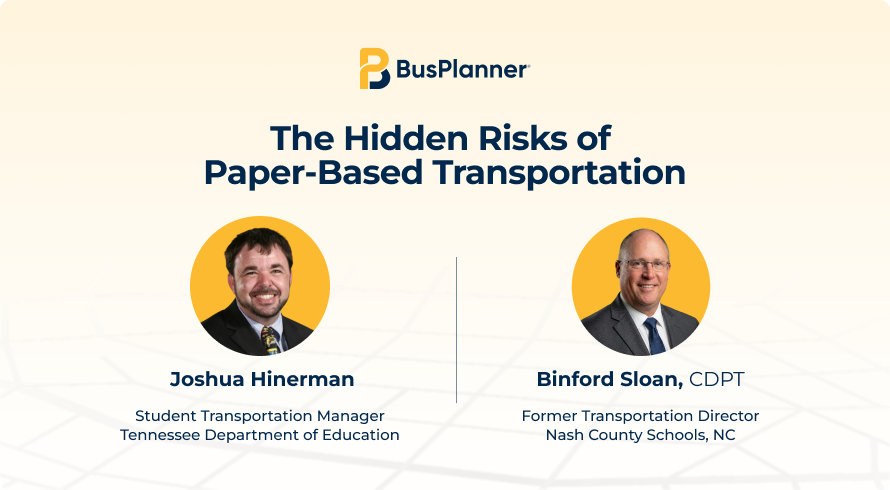
In our recent webinar, “The Hidden Risk of Paper-Based Transportation,” Binford Sloan, CDPT, Former Transportation Director, Nash County Schools, NC, and Joshua Hinerman, State Transportation Manager with the Tennessee Department of Education, explored the operational gaps that paper can leave behind. Drawing from decades of experience in student transportation, they discussed how outdated records, inconsistent documentation, manual reporting, and knowledge stored in employees’ heads can quietly create risks for districts.
Paper Is Still Part of Daily Transportation Operations
While technology has transformed many aspects of student transportation, paper continues to play a role in daily operations. From route sheets and inspection forms to incident records and mileage logs, many departments still rely on paper for at least part of their documentation process. Rather than asking whether paper should exist, the webinar focused on understanding where it fits into today’s transportation environment and where it begins to create operational challenges.

Where Paper Starts to Break Down
Some of the biggest challenges included:
- Outdated Route Information: Route sheets were sometimes updated only once a year, even as students moved and routes changed.
- Inconsistent Records: Handwritten route books varied from one driver to another, making it harder for substitute drivers to follow the same information.
- Repeated Manual Work: Drivers wrote information by hand, then office staff had to type or reorganize it later.
- Repairs Without a Clear Trail: Vehicle issues could be written on a pad without showing who completed the work or whether it was completed at all.
- Knowledge in One Person’s Head: Experienced dispatchers often knew every route from memory, leaving the operation vulnerable when they were absent or retired.
Accountability Shouldn't Depend on Memory
One of the biggest themes from the webinar was that student accountability isn’t just about knowing where students are during the route. It’s about being able to confidently answer questions long after the route has ended. Joshua Hinerman explained that transportation departments are regularly asked to verify who rode a bus, where a student exited, or what happened on a particular day. Without a reliable record, those answers often depend on someone’s memory instead of documented information.

- Reconstructing Past Trips: Questions often arise days or even weeks after a route has been completed. Looking back without a reliable record can quickly become a time-consuming process.
- Responding to Parent Inquiries: When families ask where or when a student left the bus, staff need information they can verify rather than assumptions based on recollection.
- Maintaining a Clear Audit Trail: As routes, stops, and student assignments change throughout the school year, keeping accurate historical records becomes increasingly important for accountability.
- Reducing the Burden on Staff: Accountability works best when reliable records are created as part of the normal workflow instead of relying on drivers or dispatchers to remember events after the fact.
When an Accident Becomes a Paper Chase
Incident documentation is one of the few transportation workflows that can’t wait. When an accident occurs, transportation teams need accurate information immediately, not just for reporting, but to support emergency responders, communicate with families, and account for every student involved. Joshua Hinerman reflected on how paper-based processes often added work during the moments when staff were already under the greatest pressure.
Some of the biggest challenges included:
- Student Information Wasn’t Readily Available: Drivers often had to manually gather names, addresses, and emergency contact details before they could complete reports or provide information to first responders.
- Documentation Competed With Student Car: Completing forms while managing an accident meant dividing attention between paperwork and the students involved.
- Reporting Became a Manual Process: Preparing information for law enforcement or state officials required drivers to piece together records instead of retrieving them from a single source.

Good Reporting Starts With Good Data
Compliance isn’t just about submitting reports. It’s about having confidence that the information behind those reports is complete, accurate, and easy to verify. As Binford Sloan and Joshua Hinerman reflected on their experiences, many reporting processes once depended on handwritten logs, manual calculations, and information collected throughout the year.
That created challenges in several areas:
- Manual Data Collection: Driver counts, mileage, fuel usage, and inspection records were all recorded by hand before being reviewed and consolidated by office staff.
- Small Errors Became Big Problems: A single clerical mistake could affect reporting, requiring staff to spend valuable time tracing the error back through paper records.
- Reporting Relied on Consistency: When information was captured differently from one person to another, producing reliable reports became much more difficult.
- Records Needed Better Protection: The discussion also highlighted how student information was once carried on handwritten cue cards or stored on buses, practices that would raise significant privacy concerns today.
Change Doesn't Have to Happen Overnight
Modernizing transportation doesn’t require replacing every paper process at once. The most successful districts focus on one workflow where the risk is highest, make that process part of the daily routine, and build from there. Small improvements are easier for staff to adopt, easier to measure, and create momentum for future changes.
Technology is only one piece of the modernization journey. Lasting success also depends on bringing stakeholders along, from district leadership and finance teams to drivers, schools, and parents. Building that buy-in early makes it easier to introduce new processes and expand them over time.
A phased approach also gives districts the opportunity to strengthen the foundation before adding more technology. Accurate routing data, consistent daily habits, and staff confidence create the conditions for tools like student accountability, fleet management, and parent communication to deliver their full value.
Key Takeaways
Paper-based transportation isn’t risky because of the paper itself. The real risks appear when information can’t be found, verified, or shared at the moment it’s needed most. As districts evaluate their operations, these are the key lessons from the discussion:
- The Biggest Risks Aren’t Always Visible: The real exposure comes from missing records, inconsistent documentation, and information that’s difficult to retrieve when it matters most.
- Focus On the Blind Spots First: Student accountability, incident documentation, and compliance reporting are some of the highest-risk workflows to move beyond paper.
- Start With One Process and Build From There: Choose the aa where the operational risk is greatest, establish reliable digital records, and expand at a pace your team can support.
- Better Records Lead to Better Decisions: Searchable, accessible data turns scattered paperwork into information that supports faster responses, stronger accountability, and more confident planning.
Watch the Full Webinar
This article highlights just a portion of the discussion. For more practical examples, audience questions, and guidance on reducing the risks of paper-based transportation, watch the full webinar on the BusPlanner YouTube channel.