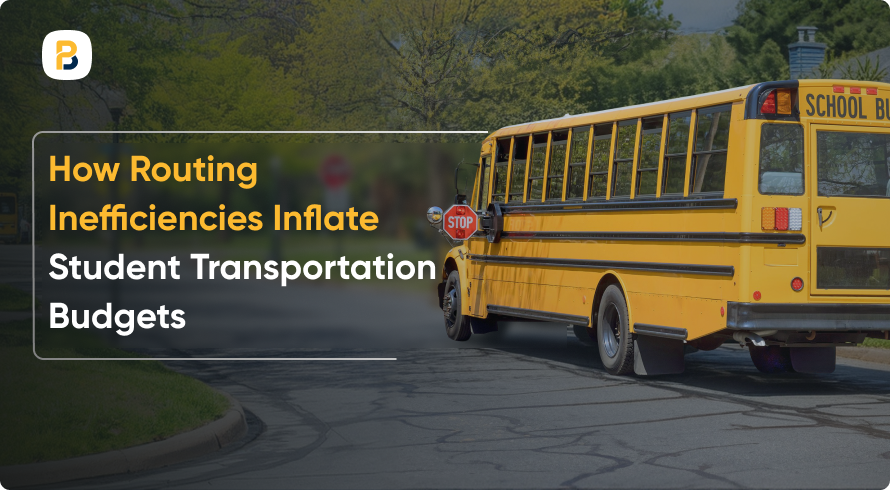
Every unnecessary mile adds fuel, labor, and maintenance costs that compound across an entire fleet. Here’s where the money goes, and how districts can get it back.
Transportation is one of the largest non-instructional line items in a school district’s budget. According to the National Center for Education Statistics, U.S. school districts were spending an average of $1,153 per student on transportation services as of the 2018–19 school year, and costs have climbed sharply since. In Minneapolis, for example, transportation spending surged over 90% between 2019–20 and 2024–25, consuming nearly 10% of the district’s operating budget.
Districts across the country face the same squeeze. Fuel prices remain volatile. The bus driver shortage persists, and amidst all of this cost pressure, one of the most controllable factors often goes unaddressed: routing inefficiency.
The Actual Cost of Each Extra Mile
Routing may not seem like a dramatic cost driver, but small inefficiencies multiply fast when you’re running dozens or hundreds of buses twice a day, 180 days a year. Every extra mile on a route triggers a cascade of costs that transportation directors don’t always see in a single line item.
- Fuel Cost: School buses are not fuel-efficient vehicles, and that reality only worsens in suburban and urban stop-and-go conditions. At current diesel prices, an unnecessary five-mile detour per route doesn't sound like much, until you multiply it by the number of routes, by two runs a day, by 180 school days. Across a fleet, the dollars add up rapidly.
- Labor Cost: Driver labor is the next domino. Longer routes mean more paid hours. In districts where drivers are compensated by the hour rather than by the route, even modest time overruns add up. And given today's tight labor market for CDL drivers, paying overtime or relying on emergency substitutes compounds the problem further.
- Maintenance of Vehicles: Vehicle wear and maintenance are the slow bleed. Extra mileage accelerates tire wear, shortens brake life, and moves up major service intervals. That's more frequent trips to the shop, more parts, more downtime, and when a bus is down, the fleet has less flexibility to absorb disruptions.
Where Routing Inefficiencies Hide
The challenge is that routing waste isn’t always visible. It accumulates in places that don’t trigger alarms on their own but collectively represent a significant drain on the budget.
Deadhead Miles:
The distance a bus travels empty, either heading to the start of a route or returning to the depot is purely wasted budget. In well-optimized operations, transportation leaders aim for a ratio of roughly 65% live miles to 35% deadhead. But without careful attention to how buses are assigned and where they’re garaged, deadhead percentages can creep well above that threshold. If buses aren’t paired efficiently with nearby schools and runs, districts end up paying for miles that transport no students at all.
Legacy Routes That Were Never Re-Optimized:
Many districts are running routes that were originally designed years ago, adjusted incrementally as enrollment shifted, but never truly rebuilt from scratch. A stop added here, a turn sequence tweaked there: over time, these layered changes introduce redundancies. Roads that once made sense may now be congested, or student addresses may have shifted to different parts of the district. Without a periodic reset, routes drift further from optimal with each passing year.
Driver Route Deviation:
Even a carefully planned route is only as efficient as its execution. When drivers alter their scheduled turn-by-turn directions, sometimes out of habit, sometimes to avoid a perceived obstacle, the actual miles driven may exceed the planned miles. Without GPS monitoring to flag deviations, this is a cost leak that goes entirely undetected.
Underutilized Bus Capacity:
When routes aren’t designed to maximize ridership across tiers and school groupings, districts end up deploying more vehicles and more drivers than the student population actually requires. Grouping schools by proximity and staggering bell times are proven strategies to improve seat utilization, but they require sophisticated planning that manual methods struggle to deliver.
One hour of idling burns approximately half a gallon of diesel fuel, and for every hour a bus idles, overall fuel economy degrades by about 1%. Excess stops, route congestion, and mismanaged layovers all contribute to idle time that erodes fuel budgets.
The Ripple Effects Beyond the Budget
Routing inefficiency isn’t just a financial problem. It creates operational strain that radiates outward into every corner of a transportation department.
- Driver Retention Suffers: When routes are longer, more frustrating, and poorly balanced, drivers feel the impact in their daily experience. Recruiting and training a new bus driver costs thousands of dollars per hire. In a labor market where districts are already competing with delivery services, ride-share companies, and other CDL employers, anything that makes the job harder accelerates turnover, and turnover is one of the most expensive hidden costs in transportation.
- Service Reliability Declines: Inefficient routes produce late arrivals, inconsistent pickup times, and longer ride durations for students. Parents lose confidence. Administrators field complaints. And in the worst cases, students miss instructional time, a cost that doesn't appear on any balance sheet but matters more than any line item.
- Environmental Impact Grows: Every unnecessary mile adds to the fleet's emissions footprint. As districts face increasing pressure to reduce their environmental impact, and as some explore the transition to electric vehicles, minimizing wasted mileage becomes a prerequisite for achieving sustainability targets, not just a financial exercise.
What Smarter Routing Actually Looks Like

Addressing routing inefficiency doesn’t require a district to overhaul its entire operation overnight. It starts with visibility, understanding where waste exists, and then applying the right tools to eliminate it systematically.
- Audit Routes Regularly: Route optimization is not a one-time exercise. Student populations shift. New housing developments go in. Schools open, close, or change bell schedules. Districts that treat their routing plan as a living system, revisiting and rebuilding routes annually or even mid-year, consistently outperform those that let routes stagnate.
- Leverage Routing Software: Modern routing software can analyze student distribution, road conditions, traffic patterns, and stop locations to generate routes that minimize mileage, reduce idle time, and balance driver workloads. What takes a human planner days or weeks of manual effort, purpose-built software can accomplish in hours, and with a degree of optimization that manual methods simply cannot match.
- Monitor Actual vs. Planned Performance: GPS tracking and telematics data close the gap between what routes are supposed to look like and what actually happens on the road. Identifying deviations, excessive idling, and unauthorized stops gives transportation directors the information they need to coach drivers, adjust routes, and quantify waste in real terms.
- Consolidate Strategically: Pairing schools that are geographically close, staggering start times to enable multi-tier runs, and matching bus capacity to actual ridership can all reduce the total number of vehicles required. Even modest fleet reductions have outsized budget impact when you account for the full cost of operating each bus, not just fuel, but insurance, maintenance, parking, and driver compensation.
The Opportunity in Front of Every District
School transportation budgets are under pressure from every direction: rising fuel costs, a persistent driver shortage, growing demand for specialized services, and tightening public funding. Districts can’t control the price of diesel or the national labor market. But they can control how efficiently their buses move.
Routing is the one lever that affects fuel, labor, maintenance, fleet size, service quality, and driver satisfaction simultaneously. And in an environment where every dollar redirected from transportation overhead is a dollar available for classrooms, the case for smarter routing has never been stronger.
The districts that thrive under budget pressure aren’t necessarily the ones with the most money. They’re the ones that make the most of every mile.