Routing software, GPS, tablets, and parent apps are now standard in most districts, but running multiple tools is not the same as running a connected operation. The departments performing well today aren’t the ones with the most technology. They’re the ones whose technology actually works together.
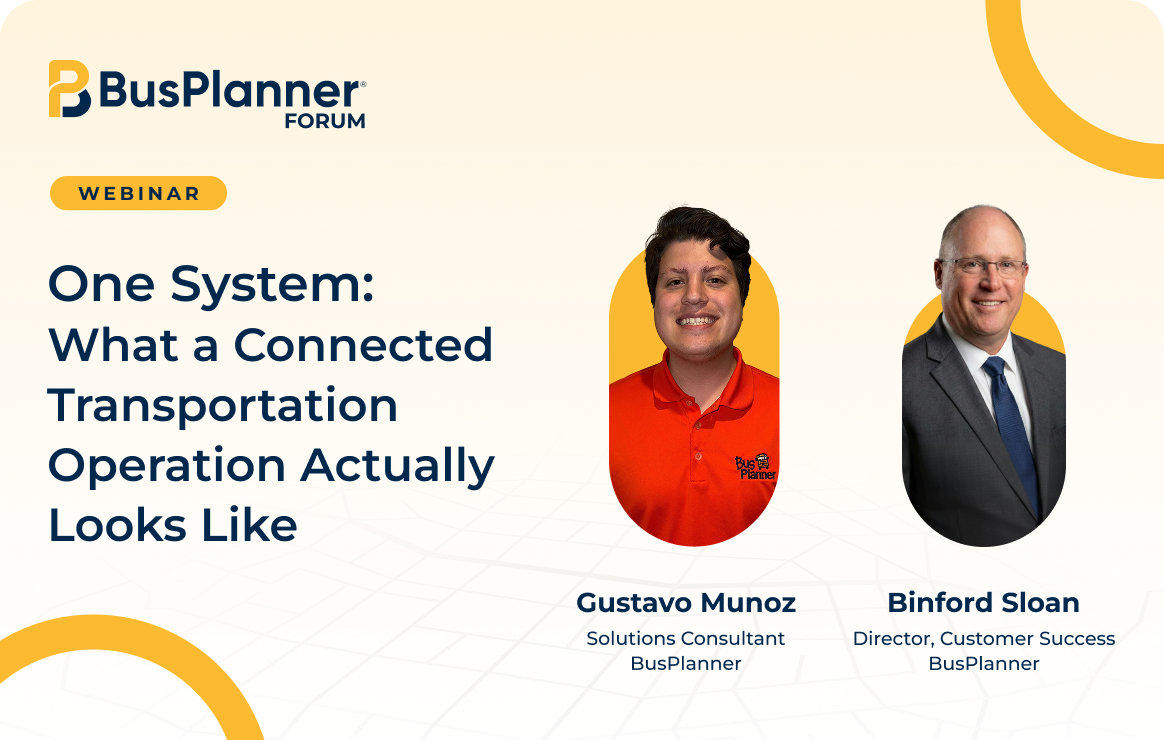
During our recent webinar, Gus Munoz, Solutions Consultant at BusPlanner, and Binford Sloan, Director of Customer Success at BusPlanner, unpacked the real costs of fragmentation for transportation teams and what a unified system looks like in practice.
Why Districts Are Moving to One System
Transportation teams are being asked to do more with less every year. Budgets are flat or shrinking, driver shortages remain unresolved, and parent expectations keep climbing.
“Transportation teams are running sophisticated operations on tighter budgets than ever, and they’re being asked to wear fifty hats at the same time,” Munoz said.
The result is a growing gap between what a department is expected to deliver and the tools available to deliver it. In a webinar poll, 71% of attendees reported using two or more vendors across routing, GPS, tablets, and parent communication. That fragmentation is exactly where time, money, and accuracy get lost.

The True Cost of Disconnected Systems
When data lives on separate platforms, workflows become heavier. Sloan, who spent nearly 25 years as a Director of Transportation, put it simply: “When you don’t have technology that breaks down those barriers, communication is where things fall apart.”
- Slower Decisions: Routers check the routing software, dispatchers pull up the GPS, and someone else opens a spreadsheet. By the time the picture is complete, the situation may have already changed.
- Harder Big Decisions: Bell time changes, redistricting, and contract renewals need a complete picture of routes, ridership, and costs. When that data is scattered, the analysis takes longer, and the conclusions are less confident.
- Integration Delays: Getting two systems to talk to each other is rarely a one-time fix. When something breaks, vendors point fingers and operations pay the price.
- Inconsistent Stakeholder Experience: When the back-end is fragmented, parents wait too long for answers, drivers miss important route changes, and principals are left calling to find buses themselves. Every disconnected workflow eventually shows up in a stakeholder conversation.
What “One System” Actually Means
A connected platform is not about consolidating logos. It is about making sure every piece of data a transportation team needs is available in one place, in real time, to the people who need it.
Gus breaks a connected operation into three buckets:
1. The Plan: Student Routing
Which students are going where, at what time, on which bus, and how that gets communicated to parents, schools, and drivers.
2. What Actually Happens: Where Buses Are & How They’re Doing
GPS, real-time location, vehicle health, and progress against the plan. This is the operation as it actually happens, tracked against the plan in real time so dispatchers can adjust the moment something shifts.
3. The Connective Layer
This is everything that turns a route plan into a working operation: tablets, ridership scans, parent communication, pre- and post-trip inspections, fleet maintenance, and financial tracking. When each of these shares data with the routing and GPS systems, the whole operation functions as one system.

Beyond Routing, GPS, and Tablets
A unified platform also brings together:
- Redistricting & Zoning Analysis: Boundary changes can be modeled against current routes and student data to assess operational impacts before any decisions are finalized.
- Bell Time Scenario Modeling: Schedule changes can be tested in advance to understand their impact on routes, drivers, and overall costs.
- Turn-by-Turn Navigation: Drivers, especially substitutes, receive directions tied directly to the route plan.
- Parent Communication: Automated route updates, delay notifications, and bus arrival alerts keep parents informed without manual outreach.
- Field Trip Booking & Assignment: Field trips are coordinated alongside daily routes to keep drivers, buses, and timelines aligned.
- Fleet Maintenance & Fuel Data: Vehicle health, fuel usage, and inspection records are tracked in the same system that runs your routes.
- Financial Tracking: Cost per mile, per route, and per contract is monitored using the same data your operations team uses every day.
- Sign-Up & IEP Coordinator Forms: Transportation requests and special needs information are routed directly into the workflow.
- Dispatching Tools: Real-time changes, driver assignments, and route adjustments are managed without switching platforms.
When these tools share a single source of truth, every change automatically ripples through the right channels.
A connected system doesn’t just store data. It automatically pushes the right information to the right people.

Key Takeaways for Transportation Teams
Districts evaluating their tech stack don’t need more tools. They need their tools to work together. Based on the webinar discussion, transportation leaders can start by:
- Audit Your Vendor Footprint: Count how many separate platforms are involved in daily operations. The more vendors, the more places data can break down.
- Identify Manual Data Handoffs: Look for instances where staff manually transfer information between systems. Every manual transfer is a potential source of errors and delays.
- Map Decision Bottlenecks: Pinpoint which decisions are slowed because the data needed lives in too many places. These are the workflows that the integration will improve first.
- Replace Manual Updates with Automation: Identify routine parent and school communications that can be automated when routes or schedules change.
- Ask Vendors the Right Questions: Evaluate integration capabilities, training approach, and whether their team actually understands pupil transportation.