

School redistricting conversations rarely start with transportation. They typically begin when superintendents or school boards identify enrollment imbalances, approve new facilities, or face school closures. But here’s the thing: while transportation may not be the reason redistricting starts, it has everything to do with how those plans actually work in practice.
During a recent webinar, “Redistricting Through the Lens of K-12 Transportation,” Gus Munoz, Solutions Consultant at BusPlanner, walked through how transportation teams can advocate for themselves during redistricting, what data matters most, and how to model scenarios before decisions get locked in.
What Triggers Redistricting?
Districts usually begin this process for a few common reasons: enrollment imbalances in which some schools overflow while others sit half-empty, new bond funding to open facilities in growing areas, consolidating underenrolled buildings, or adjusting boundaries to match demographic shifts.
Common triggers include:
- Enrollment Changes: Buildings operating over or under capacity
- New Facilities: Bond-funded schools in expanding areas
- School Closures: Budget-driven consolidation
- Demographic Shifts: Population movement requiring boundary updates
- Program Expansions: Full-day kindergarten or specialty offerings
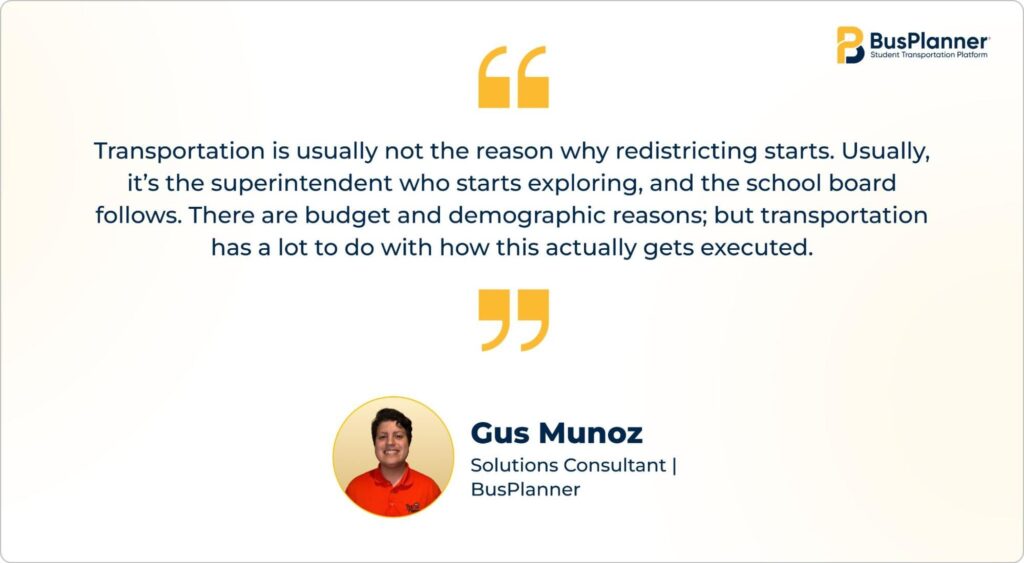
The problem? Teams often get pulled into these discussions late, sometimes only after final approvals are in place. By that point, route modifications, staffing requirements, and budget impacts become implementation details instead of planning factors.
Why Transportation Needs to Be in the Room From Day One
Here’s the reality: transportation leaders across North America face the same challenge when redistricting comes up. They need to advocate for their role in the conversation, but they need the right data and questions ready to make their case.
“We are here to help give you the data, help give you the right sets of questions to ask so you can go and get that seat at the table so you can advocate for yourself,” Gus emphasized.
When transportation gets excluded from early planning, districts risk some serious consequences:
- Budget Surprises: Route changes might need more buses or additional runs that weren't accounted for
- Staffing Headaches: Driver shortages and scheduling conflicts that could have been avoided
- Missed Efficiencies: Small boundary tweaks or bell schedule changes could have consolidated routes or saved runs
Transportation teams that show up with real data, current route costs, run times, ridership patterns, scenario models, have a much stronger position to influence decisions before they get locked in.
The Hidden Challenges of Redistricting
Apart from drawing new boundaries or creating routes, redistricting creates ripple effects that aren’t visible on a map.
Route Times Quietly Creep Up
A boundary change that looks minor on paper can add 10-15 minutes per route. Those minutes compound throughout the day, potentially requiring additional buses or leading to overtime.
Gus stressed tracking more than just miles: “Your miles, your hours, your cost, keep track of that too.”
Driver Shortages Get Worse
Driver shortages remain the top operational challenge for transportation departments nationwide. Redistricting can make staffing strain worse if:
- New routes require more drivers than you have available
- Run times increase, making schedules less manageable
- Route consolidation eliminates double runs that previously helped manage capacity
Bell Schedules Change Everything
Different districts have different transportation eligibility rules. An elementary student might need to live more than two-tenths of a mile from school to qualify for busing. Middle schoolers might have a threshold of three-tenths of a mile.
“Bell schedules are changing, your early-ins or early-outs. All of that also fits into this fold of redistricting and the changes that are coming,” Gus explained.
Eligibility Rules Create Unexpected Changes
Different districts have different transportation eligibility rules. An elementary student might need to live more than two-tenths of a mile from school to qualify for busing. Middle schoolers might have a threshold of three-tenths of a mile.
When boundaries change, eligibility zones shift too. Transportation teams need to model how these changes affect ridership and route requirements.
What Data You Actually Need Before Redistricting Starts
Effective scenario modeling starts with knowing where you stand. Before redistricting conversations even begin, transportation teams should have a clear baseline of their current operations.
Know Your Current Numbers
- Total Route Miles & Hours: both loaded with students and without (deadhead)
- Cost Per Mile & Per Student This will enable you to show the budget impact clearly
- Driver Assignments & Availability: Assess whether you have staffing capacity
- Ridership By Route & Stop: Spot utilization patterns and inefficiencies
- Overtime Trends: Understand where strain already exists
Get Your Student and Geographic Data Clean
- Enrollment Projections: Where is growth or decline expected?
- Current Boundaries & Eligibility Zones: You can compare against proposed changes
- Stop-level Ridership: Identify zero-load stops or underutilized pickup points
- Travel Times By Neighborhood: Model realistic new route scenarios

Scenario Modeling: Test It Before You Commit
Redistricting decisions are inherently political. School boards weigh competing priorities, community pressure, and budget constraints. Transportation teams that can model multiple scenarios give leadership the ability to see tradeoffs before making final calls.
What Should You Model?
- Boundary Changes: What happens if School A absorbs students from School B?
- New School Openings: How many new routes do you need, and what's the actual cost?
- School Closures: Can you consolidate routes, or will displaced students need entirely new service?
- Bell Schedule Adjustments: Can your current route tiering still work, or will you need more buses?
Gus encouraged teams to model conservatively and track all changes: “Play with it, tweak it on the margins, and then compare those numbers. If those numbers go up, your miles, your hours, your cost, keep track of that too.”
Show Leadership the Real Tradeoffs
Presenting multiple scenarios with clear cost and operational impacts helps decision-makers understand what they’re actually choosing between.
When you present multiple options, the conversation shifts from “Can you just make it work?” to “Which tradeoff makes the most sense for our district?”
Don't Forget About Parent Communication
Redistricting doesn’t just change transportation operations; it changes family routines. New routes, different pickup times, and longer rides can trigger confusion and a flood of parent calls.
Gus highlighted the importance of being proactive: “Trust and openness will get you a very long way as a general rule of thumb.”
Transportation teams should prepare for:
- Parent Questions: What's my child's new stop? What time is pickup now?
- Community Concerns: Why is our neighborhood switching schools?
- School Staff Coordination: How will bell schedule changes affect when students arrive?
Clear, timely communication reduces confusion and builds trust. Standardizing how you communicate with parents and automating notifications where possible helps manage call volume without overwhelming your team.
Contingency Planning: When Plans Change at the Last Minute
Redistricting rarely goes exactly as planned. Construction gets delayed. Enrollment numbers surprise everyone. School boards make last-minute changes.
“Use things like grade rollovers. At the end of the school year, we anticipate that the fourth graders are going to become fifth graders. You could model that. You can allow this grade rollover to occur, and it’ll happen automatically. And so you still have the bones of what it would have been without the new change already in place.”
This approach means if redistricting plans fall through, you’re not scrambling to rebuild everything from scratch. You can revert to your baseline and adjust incrementally instead of starting over.
Think Long-Term: Redistricting Decisions Stick Around
Redistricting isn’t a one-time event. The decisions made today shape your transportation operations for years to come. A boundary change that seems minor now can compound over time as enrollment shifts, programs expand, or new development happens.
Keep tracking:
- Year-over-year Route Changes: Are costs increasing faster than enrollment?
- Ridership Trends: Are routes becoming more or less efficient over time?
- Staffing Strain: Is overtime creeping up, or are driver vacancies growing?
Regular data reviews help you spot emerging issues early and make the case for adjustments before small problems become big crises.
Key Takeaways for Transportation Teams
Districts don’t need to cut service or compromise safety during redistricting, but they do need transportation at the table with good data. Here’s what matters most:
Before Redistricting Planning Starts:
- Document your current route costs, miles, hours, and ridership patterns
- Clean up student data so your models are accurate
- Identify inefficiencies that redistricting could fix (like zero-load stops or excessive deadhead miles)
During The Redistricting Process:
- Request a seat at planning meetings from day one
- Model multiple scenarios showing cost and operational impacts
- Present findings clearly to leadership with confidence
- Advocate for transportation’s role throughout the decision-making process
After Decisions Get Made:
- Model the final plan in detail to understand the true impact
- Communicate proactively with parents and school staff
- Keep contingency plans ready in case decisions change
- Track outcomes over time to inform future planning
Throughout Everything:
- Build trust through transparency and clear communication
- Use data to defend budgets and advocate for resources
- Stay flexible and ready to adjust as plans evolve

Transportation teams that prepare with data, model scenarios proactively, and communicate clearly are better positioned to protect service quality, control costs, and make sure redistricting decisions actually account for operational realities.
Want to learn more about modeling redistricting scenarios? Learn how BusPlanner’s redistricting and zoning software can help you test boundary changes, model bell schedule impacts, and advocate for transportation’s role in district planning decisions.