Every school district knows its cost-per-student number. It shows up in budget presentations, board meetings, and state reports. But if you lined up ten transportation directors and asked them exactly what goes into that figure, you’d get ten different answers.
That’s the problem. Cost per student is treated as a universal benchmark when, in practice, it’s anything but. The inputs vary, the methods differ, and the number itself can mask the very inefficiencies it’s supposed to reveal. Understanding what this metric actually captures, and what it hides, is the first step toward making smarter transportation decisions.
The Number Everyone Quotes
The most commonly cited figure comes from the National Center for Education Statistics, which reported a national average expenditure of $1,152 per student transported in the 2018-19 school year. That figure has since climbed, with some states and districts now spending well above that.
But national averages obscure enormous variation. Geography, population density, special education requirements, and state funding formulas all play a role. A rural district covering hundreds of square miles will naturally spend more per rider than a compact suburban one. Urban districts face their own pressures: congestion, complex routing, and higher labor costs.
What Actually Goes Into the Number
Cost per student sounds like a simple calculation: total transportation spending divided by total students transported. In reality, what counts as “total spending” is where things get complicated.
Labor cost dominates as drivers, aides, dispatchers, and supervisors account for roughly half of most transportation budgets. And those costs have been climbing. In a competitive labor market, districts are offering signing bonuses, higher hourly wages, and more hours just to fill seats behind the wheel.
Then there are the costs that many districts don’t fold into their per-student number at all: administrative overhead, technology systems, facility costs for bus depots, training programs, and compliance-related expenses.
Some districts count contracted transportation separately. Others lump special education transport into a different budget line entirely. The result is a metric that can vary wildly depending on accounting choices rather than actual efficiency.
The Hidden Costs Most Districts Miss
Overtime and Emergency Coverage
When driver positions go unfilled, the remaining staff pick up the overtime. Routes get consolidated. Some districts hire emergency contractors at premium rates to cover gaps. These costs spike unpredictably and often don’t appear in baseline per-student figures.
Fleet Age and Maintenance Spirals
An aging bus fleet creates a slow-moving budget problem. Older vehicles break down more frequently, require costlier parts, and spend more time out of service. When one bus goes down, spare ratios get stretched, and domino effects ripple through the schedule. One transportation coordinator recently noted that bus costs have doubled over the past decade, while state funding for fleet renewal has stayed flat.
Fuel Volatility
Fuel is the line item that moves the fastest. A district running thousands of miles a day through its fleet can feel even a modest price increase within weeks. Unlike a household cutting discretionary trips, a school district can’t decide to skip a route. Those miles are fixed obligations.
The Funding Gap Is Real
In some states, allocated transportation funding covers only a small portion of what districts actually spend. The rest comes from general operating budgets, often forcing trade-offs between bus service and academic programs.
Special Education Transport
Specialized routes for students with IEPs can cost several times more per rider than general education routes. Smaller vehicles, trained aides, specific equipment, and strict scheduling requirements all contribute. Yet these costs are frequently siloed in different budget categories, making the “average” cost-per-student number misleading.
Why the Benchmark Breaks Down
When districts compare their cost-per-student number against peers, they’re often comparing apples to oranges. A district that contracts all transportation will report costs differently from one that runs its own fleet. A district in a state with full transportation funding will show different patterns than one where the local budget absorbs nearly everything.
State funding models vary enormously. Some states allocate based on the number of students transported and miles driven. Others use flat per-student amounts. Some send lump sums. A few provide no state assistance for transportation at all. These differences mean the same cost-per-student figure can represent very different fiscal realities.
The most useful cost-per-student number isn’t the one you report. It’s the one you calculate honestly, including every dollar your district actually spends to move kids to school.
The real value of this metric isn’t in comparing yourself to a national average. It’s in tracking your own number over time, understanding what’s driving it, and identifying where targeted improvements can move it in the right direction.
From Metric to Action: What Moves the Needle
Route Efficiency
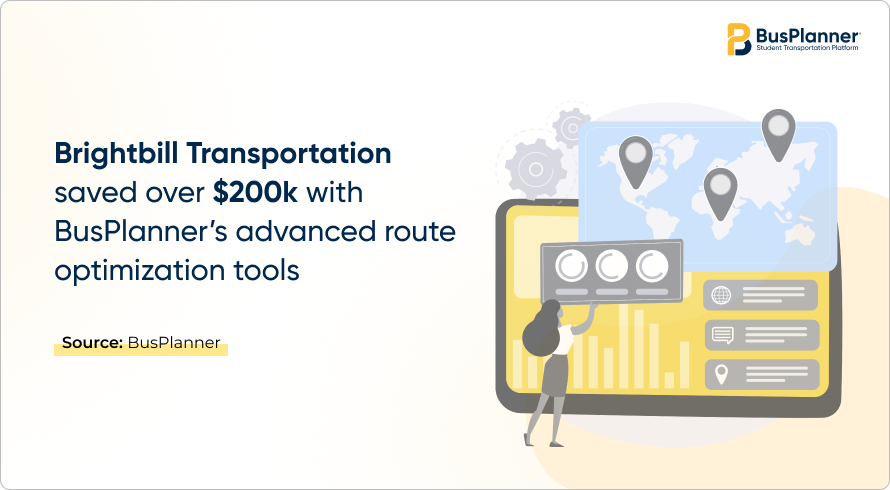
Redundant routes, excessive deadhead miles, and unbalanced loads are among the most common sources of inflated costs. Districts that invest in route optimization consistently report meaningful reductions, both in the number of buses required and the total miles traveled. Some have eliminated some of their routes through better planning alone, with each eliminated route saving costs.
Bell Time Coordination
Staggered school start and end times allow districts to tier their bus usage, meaning one bus can serve multiple schools in a single morning. This directly reduces the number of vehicles and drivers needed, and it’s one of the highest-impact levers a district can pull without spending a dime on new equipment.
Data-Driven Fleet Planning
Understanding exactly what each bus, each route, and each driver costs per day enables better forecasting and smarter resource allocation. When you can compare planned costs against actual costs in real time, you catch inefficiencies before they compound. Dynamic cost tracking with a student transportation financial planning tool also strengthens board presentations and state reporting, because the numbers reflect reality rather than estimates.
Right-Sizing to Demand
Not every route needs a full-size bus. Matching vehicle size to actual ridership prevents waste. Similarly, reviewing stop placement, walk-to-stop distances, and transfer points can reduce total ride time and mileage while maintaining safe, equitable access.
The Real Question Behind the Number
Cost per student isn’t just a financial metric. It’s a proxy for how well a district is managing one of its most complex and visible operations. A low number means nothing if service quality suffers. A high number might be entirely justified by geography, regulatory requirements, or population needs.
The districts that manage transportation costs most effectively aren’t chasing a benchmark. They’re building systems that give them visibility into where every dollar goes, how every route performs, and where the next opportunity for improvement lives. They’re using that data to make decisions proactively rather than reactively. And they’re treating transportation not as a cost center to minimize, but as an essential service to optimize.
That shift in mindset, from cost-cutting to cost-clarity, is what separates districts that merely survive budget season from those that build transportation programs they can sustain and be proud of.
FAQs
Q1. What are the biggest drivers of transportation cost increases?
Labor is the largest factor, typically accounting for roughly half of a transportation budget. Driver shortages have pushed wages, overtime, and emergency contractor costs higher. Fleet aging, fuel volatility, and growing special education transportation requirements are also significant contributors.
Q2. How can districts reduce their cost per student?
The most effective levers include route optimization to eliminate redundant miles and buses, bell time staggering to tier vehicle usage across multiple schools, right-sizing vehicles to actual ridership, and implementing data-driven fleet and cost tracking. These strategies focus on efficiency rather than service cuts.