
Every Transportation Director knows that routing is where operational strategy meets daily reality. When routes are inefficient or unstable, the ripple effects hit budgets, driver morale, parent communication, and student safety.
North America currently has nearly half a million school buses that transport the majority of its 27 million K-12 students. At that scale, even small routing inefficiencies compound quickly, adding thousands of excess miles, unnecessary overtime, and avoidable parent complaints over the course of a year.
Let’s break down the most common challenges in school bus routing and practical ways districts are addressing them.
Inaccurate or Outdated Student Data
Routing decisions are only as strong as the data behind them. Enrollment shifts, address changes, and program transfers can quietly disrupt route efficiency if data is not updated in real time.
- Frequent Student Mobility: Students move, transfer programs, or update addresses throughout the school year. Without timely data updates, routes become overloaded or underutilized.
- Manual Data Entry Errors: Spreadsheet-based routing increases the risk of duplication and outdated addresses, which can create missed stops or safety concerns.
- Disconnected Systems: When student information systems and routing tools are not integrated, transportation teams spend valuable hours reconciling data instead of optimizing service.
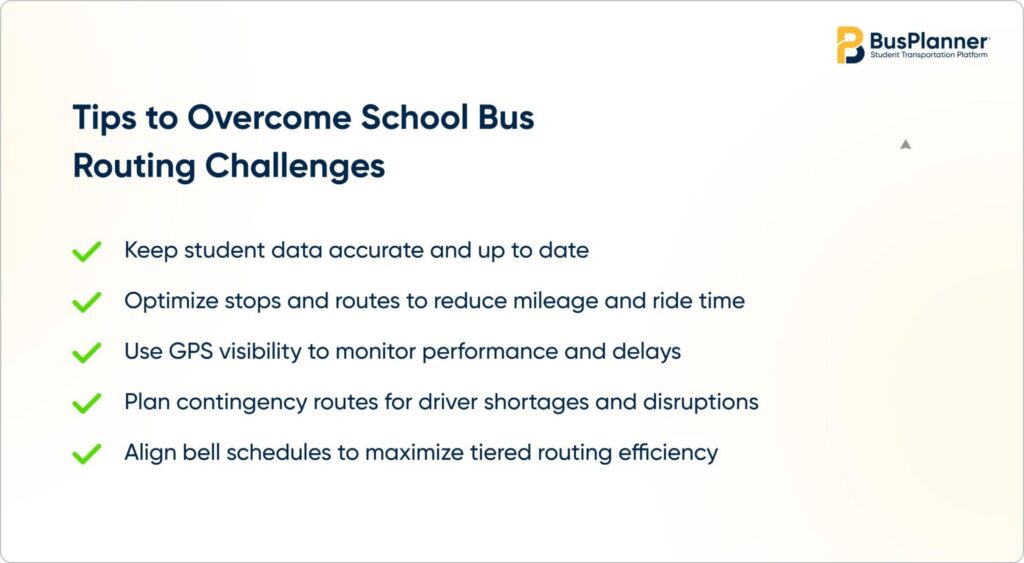
Districts are increasingly prioritizing automated SIS integrations and routine data audits. Clean, synchronized data creates a stable foundation for route optimization and reduces mid-year disruptions.
Driver Shortages and Route Coverage Gaps
Staffing shortages directly impact routing stability. When drivers are unavailable, carefully built routes quickly unravel.
- Collapsed Tiered Routing Plans: When substitute coverage is thin, districts are forced to merge or extend routes, increasing ride times.
- Increased Overtime Costs: Covering gaps often requires overtime pay, which strains already tight transportation budgets.
- Reduced Service Reliability: Inconsistent service erodes parent trust and increases call volume to the dispatch center.
Building contingency routes in advance reduces disruption and allows dispatchers to act quickly without sacrificing efficiency.
Traffic Congestion and Construction Disruptions
Traffic patterns are changing across North America. Increased car ridership and urban development are creating unpredictable delays, resulting in lost time and fuel. For school districts, that translates directly into longer ride times and higher fuel consumption.
- Unpredictable Travel Times: Static route plans do not account for seasonal or construction-related detours.
- School Site Bottlenecks: Parent drop-off traffic significantly impacts bus arrival efficiency.
- Limited Visibility Into Delays: Without GPS visibility, dispatchers rely on driver radio updates rather than real-time data.
Districts are leveraging student transportation software to capture GPS data and analyze historical travel times, allowing them to continuously refine routes throughout the year.
With real-time visibility into bus locations and delays, dispatch teams can anticipate issues, adjust routes as needed, and communicate efficiently with schools and parents.
Special Needs and Program Variability
Routing complexity increases significantly when districts serve diverse learning programs and specialized transportation requirements.
- Individualized Pickup Requirements: Door-to-door service and aide assignments require precise routing logic.
- Equipment Constraints: Wheelchair securement and lift capacity limit bus assignment flexibility.
- Bell Time Variability: Magnet, charter, and alternative programs create overlapping service windows.
Advanced routing tools that account for vehicle constraints, aide assignments, and bell-time layering allow districts to manage complexity without overextending fleet capacity.
Rising Fuel and Operational Costs
Fuel remains one of the largest variable expenses in student transportation. Even minor routing inefficiencies compound across daily runs.
- Excess Mileage: Poor stop clustering and outdated routing logic increase daily mileage, accelerating maintenance costs alongside fuel expenses.
- Idle Time at Schools: Extended loading windows waste fuel and driver time. Over a school year, those idle minutes translate into significant cost leakage.
- Inefficient Tier Planning: Misaligned bell schedules reduce the ability to reuse buses across runs, forcing districts to operate more vehicles than necessary.
Data-driven stop optimization, tighter tier alignment, and idle-time monitoring help districts control variable costs without reducing service levels. Even incremental efficiency gains can result in meaningful annual savings.
Conclusion
School bus routing is no longer just a logistical exercise; it is a strategic function that directly influences cost control, service reliability, and community trust.
Districts that invest in accurate data, scenario planning, GPS visibility, and continuous route optimization are better positioned to manage complexity and rising operational pressures. Transportation efficiency starts with smarter routing decisions.
Contact us to learn how BusPlanner’s all-in-one student transportation platform can help your district build stable, cost-effective routes with greater confidence.
Frequently Asked Questions
What is school bus routing, and why is it important?
School bus routing is the process of designing routes, stops, schedules, and vehicle assignments to safely transport students to and from school. Efficient routing reduces costs, improves on-time performance, supports driver satisfaction, and enhances student safety.
What factors most commonly disrupt bus routes during the school year?
Frequent student moves, address changes, driver absences, traffic disruptions, construction, weather events, and program changes can all destabilize routes if systems are not designed to adapt quickly.
How often should districts update routing data?
Best practice is continuous or near real-time updates, especially when student information systems (SIS) are integrated with routing software. Many districts also perform formal audits at key points in the year (start of term, after enrollment windows, and mid-year).
How can districts improve service reliability for parents and students?
Reliable service comes from accurate data, contingency planning, real-time monitoring, clear communication systems, and continuous route refinement based on actual performance.
When should transportation teams be involved in district planning decisions?
Transportation should be involved early — especially during redistricting, school openings/closures, and bell schedule changes — because these decisions have major downstream impacts on routing feasibility, costs, and service quality.