Student transportation teams are under increasing pressure to deliver safer, more visible, and more reliable bus service, all without adding extra drivers, staff, or vehicles. Rising parent expectations for real-time visibility, accurate student tracking, and accountability mean that transportation directors must manage more data, alerts, and compliance requirements than ever before.
Advances in technology, data systems, and bus design are helping districts meet these demands. From real-time GPS tracking and driver tablets to scan-in/scan-out student tracking and enhanced vehicle safety systems, school buses are becoming smarter, safer, and more connected.
Here are a few of the newest features transportation directors need to know about that are changing how students ride the bus:
1. Advanced Driver-Assistance Systems
Modern school buses are increasingly equipped with Advanced Driver Assistance Systems (ADAS) that help prevent accidents and improve safety. ADAS enables:
- Automatic Emergency Braking: Applies brakes automatically to avoid collisions.
- Lane-Departure Warnings: Alerts drivers if the bus drifts out of its lane.
- Adaptive Cruise Control: Maintains a safe distance from the vehicle ahead.
- Pedestrian and Vehicle Alerts: Warns drivers of nearby pedestrians or vehicles.
These systems enhance driver awareness and reduce the risk of collisions, making trips safer for students.
2. 360° Cameras and Blind-Spot Monitoring
Visibility around large buses is critical. 360° cameras and blind-spot monitoring systems provide drivers with a complete view of the surroundings, helping them spot obstacles, pedestrians, and other vehicles.
- Multi-Camera Systems: Delivers real-time video feeds from all angles around the bus to improve driver visibility.
- Monitor Loading and Unloading Support: Assists drivers during student boarding and drop-off by identifying movement near the bus, preventing collisions.
- Blind-Spot Reduction: Minimizes unseen areas around school buses, lowering the risk of accidents in crowded environments.
These features are particularly useful in busy school zones.
3. Stop-Arm Cameras With Automated Enforcement
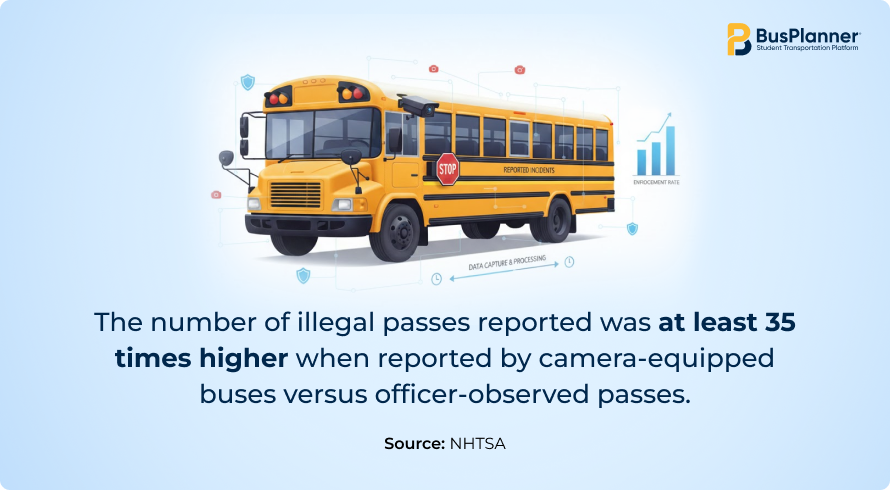
Unsafe drivers passing stopped buses pose a serious risk to students, and transportation teams often struggle to enforce compliance consistently. Stop-arm cameras automate enforcement, reduce violations, and give transportation teams documented evidence to support safety programs, improving overall accountability.
- Violation Detection: Captures clear footage of vehicles illegally passing a stopped bus.
- Automated Enforcement: Sends evidence directly to law enforcement, reducing the burden on transportation teams.
- Accountability and Compliance: Supports safety programs by documenting violations and reinforcing traffic laws.
Stop-arm cameras are a trusted safety feature that is becoming standard across many school districts, protecting students at bus stops.
4. Real-Time GPS Tracking and Fleet Telematics
Transportation teams often lack real-time visibility into bus locations, making it difficult to respond quickly to delays or route deviations. School bus GPS tracking systems give districts and parents live updates on bus location and arrival times. This enables transportation departments to:
- Live Bus Location Tracking: Provides real-time visibility into where buses are at any moment.
- Route Adherence Monitoring: Ensures drivers follow planned routes and schedules consistently.
- Delay and Incident Alerts: Notifies staff and families about service disruptions or emergencies.
- Driver Behavior Insights: Tracks driving patterns to support safer and more accountable operations.
5. Student Ridership Tracking System
With the student transportation Ridership Tracking app, student transportation departments can improve attendance tracking and safety monitoring. Students scan in when they board the bus and scan out when they exit, helping schools ensure every student is safely accounted for during transit.
- Scan-In/Scan-Out Tracking: Records when students board and exit the bus for accurate accountability.
- Wrong-Bus Detection: Alerts staff if a student boards an incorrect bus.
- Student Accountability: Helps ensure every child is accounted for throughout their ride.
6. Student Transportation Tablets
Many school districts are now equipping drivers with student transportation tablets that serve as a centralized, real-time information hub. These tablets replace paper route sheets and streamline communication, allowing drivers to access critical updates instantly.
- Digital Route Access: Replaces paper route sheets with real-time digital information.
- Instant Communication: Enables immediate delivery of updates, alerts, and instructions to drivers.
- Operational Visibility: Keeps transportation teams connected to drivers throughout the day.
Driver tablets improve communication, reduce confusion, and help drivers respond quickly and accurately to changing road conditions.
7. Three-Point Seat Belts
Seat belt use on school buses has evolved, with growing attention on three-point seat belts, which secure both the lap and shoulder. Three-point seat belts provide superior protection by better restraining students during sudden stops or collisions.
- Lap and Shoulder Protection: Secures students more effectively than lap-only belts.
- Enhanced Injury Prevention: Reduces risk of head, neck, and upper-body injuries.
- Safety Compliance Support: Aligns with evolving safety standards and state-level requirements.
While lap-only seat belts are still present on some older or smaller bus models, three-point seat belts represent a meaningful step forward in student protection, offering enhanced safety compared to lap-only restraints.
8. Electronic Stability Control (ESC)
ESC is a critical safety technology designed to help drivers maintain control during abrupt maneuvers or hazardous road conditions. By automatically detecting skidding or loss of traction, ESC applies braking to specific wheels to stabilize the bus.
- Loss-of-Control Detection: Identifies skidding or instability before it escalates.
- Automatic Stabilization: Applies braking to individual wheels to maintain control.
- Adverse Condition Support: Improves safety on wet, icy, or uneven road surfaces.
This adds an essential layer of protection by helping drivers maintain stability and control, especially during emergency situations.
Conclusion
Student transportation is evolving into a more connected, data-driven, and safety-focused system. From real-time GPS tracking and driver tablets to scan-in/scan-out student tracking, electronic stability control, and three-point seat belts, these technologies significantly improve safety. They also introduce new data streams, alerts, compliance requirements, and parent expectations that transportation teams must manage daily.
BusPlanner helps districts centralize route data, student ridership, driver communication, and exception handling so these safety technologies actually work together in real operations. To learn how districts are managing modern bus technology without adding administrative overhead, contact us today!
Frequently Asked Questions
What are the key features of a school bus?
Modern school buses combine safety, operational, and comfort features. Safety includes seat belts, cameras, and electronic stability control; operational features cover GPS tracking, student ridership systems, and driver tablets; and comfort features include spacious seating, climate control, and high-visibility lights.
Which features protect students on the bus?
School buses include multiple safety technologies to protect students, such as three-point seat belts, stop-arm cameras to prevent illegal passing, 360° cameras and blind-spot monitoring, Advanced Driver-Assistance Systems (ADAS) like emergency braking and lane-departure warnings, and electronic stability control to prevent rollovers.
Do stop-arm cameras really prevent unsafe driving?
Yes. Studies show that automated enforcement significantly reduces instances of vehicles illegally passing stopped buses and provides actionable data for law enforcement.